How provider-led health plans can succeed in commercial insurance
McKinsey Insights & Publications
20 mai 2026, 00:00
Texte de la source originale
[Skip to main content](https://www.mckinsey.com/industries/healthcare/our-insights/how-provider-led-health-plans-can-succeed-in-commercial-insurance#skipToMain)    How provider-led health plans can succeed in commercial insurance Share [Print](https://www.mckinsey.com/industries/healthcare/our-insights/how-provider-led-health-plans-can-succeed-in-commercial-insurance#/print) [Save](https://www.mckinsey.com/industries/healthcare/our-insights/how-provider-led-health-plans-can-succeed-in-commercial-insurance#/save) Summarize # How provider-led health plans can succeed in commercial insurance May 20, 2026 \| Article By [Aneesh Krishna](https://www.mckinsey.com/our-people/aneesh-krishna) with Aditya Gupta, Muhammed Ziauddin, and Nikhil Mahajan Share [Print](https://www.mckinsey.com/industries/healthcare/our-insights/how-provider-led-health-plans-can-succeed-in-commercial-insurance#/print) [Save](https://www.mckinsey.com/industries/healthcare/our-insights/how-provider-led-health-plans-can-succeed-in-commercial-insurance#/save) Summarize Provider-led health plans are underrepresented in the commercial group insurance market, leaving more than $20 billion in potential revenue and $700 million in operating margin on the table. **Commercial insurance** is a critical element in the US healthcare ecosystem. It represents the largest segment of healthcare financing, covering more than 165 million individuals in 2024, or about 62 percent of the total insured population.1Clarivate InterStudy report on the US insured population. National carriers are the leaders, with half the market by enrollment. Health systems that have developed insurance capabilities, known as provider-led health plans (PLHPs), lag behind at 10 percent. ##### How relevant and useful is this article for you? ### Most Popular Insights 1. [**The state of AI in 2025: Agents, innovation, and transformation**](https://www.mckinsey.com/capabilities/quantumblack/our-insights/the-state-of-ai) 2. [**Agents, robots, and us: Skill partnerships in the age of AI**](https://www.mckinsey.com/mgi/our-research/agents-robots-and-us-skill-partnerships-in-the-age-of-ai) 3. [**Superagency in the workplace: Empowering people to unlock AI’s full potential**](https://www.mckinsey.com/capabilities/tech-and-ai/our-insights/superagency-in-the-workplace-empowering-people-to-unlock-ais-full-potential-at-work) 4. [**The State of Fashion 2026: When the rules change**](https://www.mckinsey.com/industries/retail/our-insights/state-of-fashion) 5. [**The agentic organization: Contours of the next paradigm for the AI era**](https://www.mckinsey.com/capabilities/people-and-organizational-performance/our-insights/the-agentic-organization-contours-of-the-next-paradigm-for-the-ai-era) PLHPs have the potential to improve care coordination and affordability for members through closer alignment between care delivery and coverage. They have a big opportunity to increase their presence in the commercial market, the most financially attractive segment for payers. According to McKinsey analysis, they could capture more than $20 billion in additional revenue, equivalent to roughly 30 percent of PLHPs’ current total revenue pool, more than $700 million in operating margin, and 5.5 million more members if they aggressively pursue the opportunity.2Estimates assuming PLHPs can increase their penetration to the national average in states where market shares are below average (the current average share for PLHPs is 18 percent for fully insured and 4 percent for self-insured). In this article, we look at the challenges facing PLHPs in the commercial market, why this market is attractive, and how they could expand into the market by pursuing product innovation, optimizing pricing, and sharpening go-to-market tactics. ## Why provider-led health plans have struggled in the commercial market The commercial market structure favors large, established national carriers due to operational scale and administrative efficiency. National carriers lead with a 50 percent share of the commercial enrollment, followed by regional Blue Cross Blue Shield plans at 35 percent and PLHPs at 10 percent (Exhibit 1). Exhibit 1 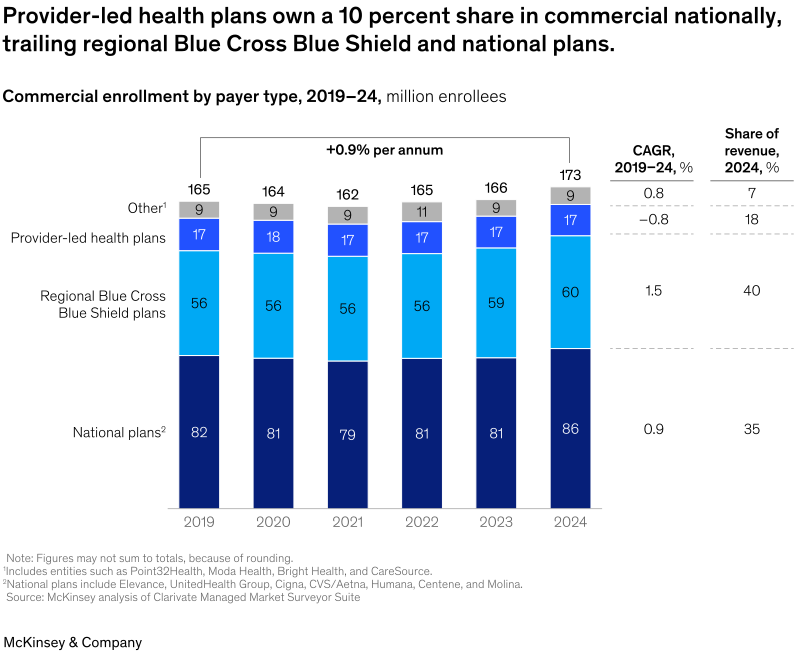 We strive to provide individuals with disabilities equal access to our website. If you would like information about this content we will be happy to work with you. Please email us at: [McKinsey\_Website\[email protected]](mailto:[email protected]) PLHPs’ operating margins lag behind industry averages. Most had operating margins of less than 2 percent in 2024, trailing national carriers and larger regional Blue Cross Blue Shield plans. The latter two achieved operating margins ranging from 3 to 8 percent (Exhibit 2). Exhibit 2 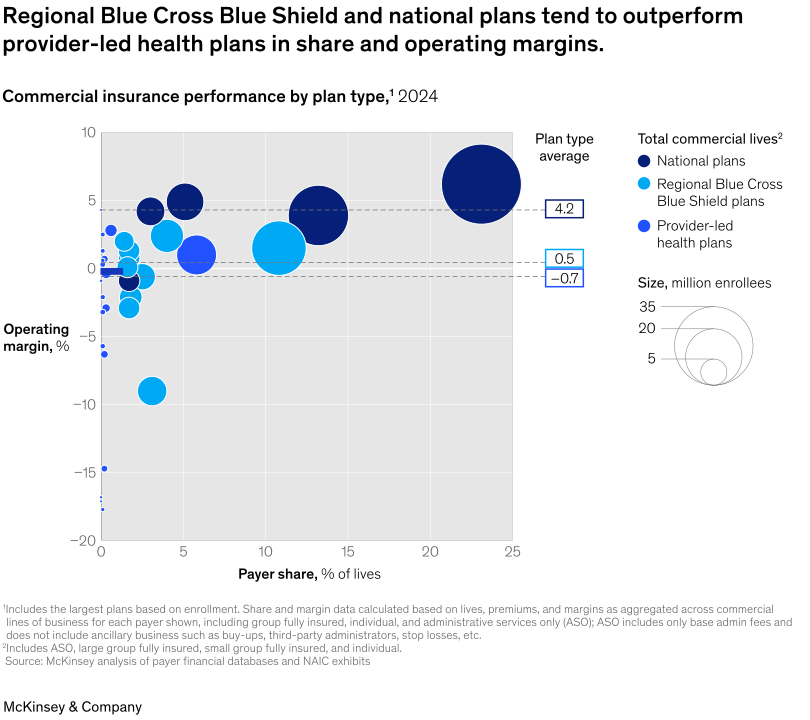 We strive to provide individuals with disabilities equal access to our website. If you would like information about this content we will be happy to work with you. Please email us at: [McKinsey\_Website\[email protected]](mailto:[email protected]) ### What has held provider-led health plans back PLHPs have struggled to increase their share of the commercial market. Structural limitations and capability gaps have prevented them from achieving the scale and competitiveness of national carriers (see sidebar, “Forces reshaping commercial markets for provider-led health plans”). Share Sidebar ## Forces reshaping commercial markets for provider-led health plans **Two major developments** are reshaping the commercial insurance landscape, presenting both risks and opportunities for provider-led health plans (PLHPs). #### Coverage shifts from Medicaid or individual to employer-sponsored plans Recent policy changes, such as a planned reduction in Medicaid funding and removal of enhanced subsidies for the Affordable Care Act (ACA) under the One Big Beautiful Bill Act, are expected to push 11 million lives out of Medicaid and ACA plans by 20341“Estimated effects on the number of uninsured people in 2034 resulting from policies incorporated within CBO’s baseline projections and H.R. 1, the One Big Beautiful Bill Act,” US Congressional Budget Office, June 4, 2025. and potentially encourage people to obtain coverage through employer-sponsored markets. PLHPs with integrated-care models and flexible plan designs would be well positioned to capture this shifting population. #### Tariff-driven cost pressures Recent tariffs are increasing provider costs (for example, drugs), with downstream effects on commercial premiums.2Matt McGough, “Tariffs are driving 2026 health insurance premiums up,” KFF, June 16, 2025. PLHPs may have a structural cost advantage through bundled pricing and operational efficiencies. But the maturity of these models varies widely across the sector, leaving some plans vulnerable to operating margin compression. The commercial market features low customer turnover and intense competition. Only 15 to 20 percent of employer groups actively seek new plans annually.3McKinsey interviews with 20 employers over the past two years. Such switching behavior favors large national carriers with broad provider networks and established broker relationships. Companies that have employees in multiple locations usually prefer carriers that can provide coverage across multiple locations and have existing ties with insurance brokers or consultants. Some of the challenges facing PLHPs in the commercial market include the following: - PLHPs’ limited geographic reach restricts their competitive scale. - Many PLHPs lack the operational infrastructure and expertise required to scale effectively. Outdated claims platforms, limited pricing sophistication, and insufficient actuarial capabilities can hinder their ability to compete with more advanced national and regional players. - Misalignment between the health system and health plan sides of PLHPs creates inefficiencies.4Zahy Abou-Atme, Michael Morley, and Gunjan Khanna, “ [How should provider-led health plans evolve?](https://www.mckinsey.com/industries/healthcare/our-insights/how-should-provider-led-health-plans-evolve),” McKinsey, December 4, 2019. For example, when the PLHP is unable to drive stronger care coordination within its own health system than that of an external payer, it can erode the PLHP’s value proposition. Similarly, the inability to establish centers of excellence (CoEs) that provide high-quality care with specialized providers may further undermine its value proposition. - PLHPs trail their national and regional competitors in product innovation. Their competitors continually introduce differentiated offerings to capture additional market share and sustain healthy operating margins. These challenges have collectively stalled PLHPs’ ability to scale, leaving many of them unable to compete effectively with the national and regional carriers that lead commercial insurance. Addressing these barriers will require a fundamental shift in strategy, investment, and execution. ## How provider-led health plans could increase their presence in commercial health insurance Commercial insurance offers attractive opportunities for PLHPs: For example, it can provide stable operating margins, a contrast with other lines of business that face pressure from higher utilization and regulatory changes. According to McKinsey analysis, the commercial group market has maintained 1 to 3 percent operating margins from 2021 to 2023, but margins dropped below 1 percent in 2024 and are expected to recover to 2 to 3 percent over the next five years. Meanwhile, government lines of business, including Medicare and Medicaid, have experienced considerable margin swings from 3 percent to less than 1 percent during the same period, and they are expected to continue to face pressure in the coming years.5Centers for Medicare & Medicaid Services; McKinsey PFD and Profit Pools datasets; NAIC exhibits; Medical Expenditure Panel Survey; Medicare Payment Advisory Commission; 10-K annual reports. Many PLHPs perceive themselves as too small to compete effectively against national or regional carriers in commercial insurance. However, McKinsey analysis indicates that scale advantages in the commercial segment diminish beyond 300,000 to 550,000 lives in fully insured agreements and beyond 400,000 to 650,000 members in administrative-services-only arrangements.6Administrative services only is a health plan arrangement in which an employer self-funds employee healthcare claims while contracting with a health plan or third-party administrator to handle claims processing, network access, and customer support. By understanding where they sit on the scale curve, PLHPs can make more-informed strategic choices: Those above the threshold can invest confidently to grow their market share, while those below can evaluate partnerships with other PLHPs or managed services organization (MSO)–type collaborations7MSOs are business entities that provide nonclinical, administrative, and operational support services to medical practices, allowing physicians to focus on patient care. to reach sustainable efficiency levels. Both approaches are addressed below. Having a commercial insurance arm could help providers stay relevant in a market that’s increasingly consolidated. Without commercial insurance capabilities, they risk being seen as easily replaceable vendors (for example, a payer could move a provider out of network). How should PLHPs seeking to enter or expand into commercial health plans proceed? They could consider several approaches, including pursuing product innovation, optimizing pricing, and sharpening go-to-market tactics. ### Pursuing product innovation PLHPs have the potential to expand access models and reduce costs for employers. To achieve these goals, PLHPs can consider the following approaches: **_Lower-cost, virtual-first plan options._** Employers that currently offer or are interested in alternative funding plans such as virtual-first plans rose by six percentage points from 2024 to 2025.8McKinsey’s 2024 National Employer Health Benefit Survey, n = 419. Question: How likely is your company to offer the following to your employees? Co-pay-only plans are growing nationwide, and some promise to save up to 15 percent in costs compared with a traditional preferred provider organization plan.9“What is the Surest health plan and why are employers switching to it,” Group Benefits, November 10, 2025. PLHPs could introduce co-pay-only health maintenance organization plans with virtual primary care to employers looking for more-affordable plan options while offering members more-predictable out-of-pocket costs and access to a network that can meet their needs. **_Third-party administrators._** PLHPs may consider building, acquiring, or partnering with a third-party administrator (TPA) to offer their clients tailored and flexible solutions.10TPAs orchestrate self-funded health plans on behalf of employers, typically providing services such as claims processing, member services, reporting, and plan compliance. According to McKinsey analysis, TPAs can provide employers with cost savings of 10 to 15 percent, as well as increased flexibility and benefit customization.11McKinsey analysis based on a calculation of an average employer savings relative to traditional fully insured plans for a 200-employee employer with a lower risk profile. PLHPs should carefully assess the financial implications of building versus partnering, noting that purchasing a TPA requires a substantial initial investment. Partnering with a TPA can expand opportunities by using its established local provider network and platform while enabling access to stop-loss and cost-containment solutions. For example, a regional health system in the Northeast partnered with a TPA to offer employers access to a provider network while empowering them to customize health plans to best meet employees’ needs. **_Stop-loss captives._** PLHPs could also consider launching stop-loss captives. These offer the advantage of allowing small- and medium-group employers to self-insure while minimizing downside risks.12Captives pool small and medium-group employers with similar risk profiles to reduce risk, lower stop-loss premiums, and access cost-containment solutions. Captives use self-insured models that pool employers with similar risk profiles to share costs and stabilize performance. Doing so can help employers gain access to better product features, such as rate guarantees, and achieve lower premiums overall. **_Centers of excellence._** PLHPs can establish specialized CoEs for high-cost, high-utilization procedures such as bariatric surgeries, organ transplants, orthopedic replacements, and cardiac interventions that employ clinical expertise and integrated-care models.13CoEs are high-quality provider networks recognized for health outcomes and efficiency for specific conditions or procedures, typically used to improve quality and reduce costs. These programs feature transparent quality metrics, risk-adjusted outcome benchmarks, bundled pricing structures, and shared accountability models between the carrier and provider teams. PLHPs are particularly well positioned to establish CoEs given their proximity to a health system. ### Optimizing pricing PLHPs can achieve sustainable financial advantages by redefining pricing levers, including the following: **_Enable AI-led underwriting capabilities._** PLHPs can enable AI-led underwriting by reimagining the underwriting journey—from intake and submission to risk selection, pricing, and delivery—through close collaboration with their data science, IT, and analytics functions. This can drive improved accuracy, and it elevates underwriter experiences by automating data processing, enhancing risk assessment, and continuously optimizing decision-making. By improving precision and speed, AI-led underwriting also enables more accurate and dynamic pricing, allowing PLHPs to align premiums more closely with actual risk. For example, a national carrier with manual underwriting processes redesigned its end-to-end underwriting process, resulting in faster turnaround time and 20 to 30 percent higher accuracy in claims cost estimation. **_Optimize administrative-services-only revenue._** PLHPs can reimagine their administrative-services-only pricing by shifting from fixed-fee programs to performance-based variable fees. These programs could include shared-savings arrangements from claim edit initiatives (which identify and correct billing errors before payment) and out-of-network cost management programs. By bundling these capabilities with transparent performance metrics and shared savings, PLHPs can generate incremental fees while delivering measurable value to self-funded employers seeking active cost-management partners. **_Build MSO-type shared-service models._** To improve operational efficiency and cost competitiveness, PLHPs could explore MSO-type arrangements with PLHPs in other markets. These shared-service platforms allow multiple plans to pool administrative functions such as claims processing, customer service, and product administration. By sharing a common operational chassis, PLHPs can reduce fixed costs, modernize core systems, and achieve economies of scale without full mergers or loss of independence. Such arrangements can help PLHPs compete more effectively on administrative expense ratios and reinvest savings into innovation and growth. ### Sharpening go-to-market tactics PLHPs can strengthen their position in the commercial market by deploying best-in-class go-to-market tactics. For example, PLHPs could segment employers to identify profiles where their plans have historically achieved the strongest traction (for example, industry verticals or employer size). By understanding segment-specific priorities such as talent attraction and retention or the need to demonstrate cost savings, PLHPs can tailor their product offering and go-to-market approach accordingly. For example, employers focused on talent could be interested in new benefit programs and solutions that improve employee experience—even when the cost-savings ROI is not proved yet. Additionally, PLHPs could strengthen their reach through strategic partnerships. While competing directly with national carriers in large multistate requests for proposal may be challenging, PLHPs can pursue a “win locally, partner nationally” strategy. Forming partnerships with regional health plans can help PLHPs expand their footprint while retaining local differentiation and positioning PLHPs as credible, flexible partners for large employers seeking value-based, regionally focused options. * * * Strategic expansion into commercial insurance could generate meaningful growth for PLHPs. Those that combine product innovation, pricing precision, and differentiated go-to-market execution can translate their clinical integration into true competitive advantage. It’s a propitious moment. Employers are seeking affordable, quality-driven solutions, which PLHPs are well positioned to deliver while improving care coordination, access, and affordability for members. The next generation of leading PLHPs will be those that act now to build sustainable commercial capabilities, balancing financial performance with their mission to improve care for the communities they serve. ##### How relevant and useful is this article for you? ##### About the author(s) **[Aneesh Krishna](https://www.mckinsey.com/our-people/aneesh-krishna)** is a senior partner in McKinsey’s Bay Area office, **Aditya Gupta** is an alumnus of the Boston office, **Muhammed Ziauddin** is a consultant in the New York office, and **Nikhil Mahajan** is an associate partner in the Atlanta office. * * * The authors wish to thank Gaurav Kohli, Mani Agarwal, and Robin Song for their contributions to this article. Talk to us ##### Explore a career with us [Search openings](https://www.mckinsey.com/careers/search-jobs) ##### Related Articles [](https://www.mckinsey.com/industries/healthcare/our-insights/ushering-in-the-next-era-of-frontline-nursing-with-ai) Article ###### [Ushering in the next era of frontline nursing with AI](https://www.mckinsey.com/industries/healthcare/our-insights/ushering-in-the-next-era-of-frontline-nursing-with-ai) [](https://www.mckinsey.com/industries/healthcare/our-insights/healthcare-blog/what-it-takes-to-build-a-high-performing-health-system-operating-model) Blog Post ###### [What it takes to build a high-performing health system operating model](https://www.mckinsey.com/industries/healthcare/our-insights/healthcare-blog/what-it-takes-to-build-a-high-performing-health-system-operating-model) [](https://www.mckinsey.com/industries/healthcare/our-insights/healthcare-revenue-cycle-management-at-a-strategic-turning-point-survey-insights) Article ###### [Healthcare revenue cycle management at a strategic turning point: Survey insights](https://www.mckinsey.com/industries/healthcare/our-insights/healthcare-revenue-cycle-management-at-a-strategic-turning-point-survey-insights) Poool - Module d'accès au contenu bloqué ##### Sign up for emails on new Healthcare articles Never miss an insight. We'll email you when new articles are published on this topic. Subscribe Sign up for emails on new Healthcare articles Checking your Browser… Verifying... Stuck? [Troubleshoot](https://challenges.cloudflare.com/cdn-cgi/challenge-platform/h/b/turnstile/f/ov2/av0/rch/zj9l9/0x4AAAAAACA2h2tXtNLvFJDI/auto/fbE/new/invisible?lang=auto#refresh) Success! Verification failed [Troubleshoot](https://challenges.cloudflare.com/cdn-cgi/challenge-platform/h/b/turnstile/f/ov2/av0/rch/zj9l9/0x4AAAAAACA2h2tXtNLvFJDI/auto/fbE/new/invisible?lang=auto#refresh) Verification expired [Refresh](https://challenges.cloudflare.com/cdn-cgi/challenge-platform/h/b/turnstile/f/ov2/av0/rch/zj9l9/0x4AAAAAACA2h2tXtNLvFJDI/auto/fbE/new/invisible?lang=auto#refresh) Verification expired [Refresh](https://challenges.cloudflare.com/cdn-cgi/challenge-platform/h/b/turnstile/f/ov2/av0/rch/zj9l9/0x4AAAAAACA2h2tXtNLvFJDI/auto/fbE/new/invisible?lang=auto#refresh) [Troubleshoot](https://challenges.cloudflare.com/cdn-cgi/challenge-platform/h/b/turnstile/f/ov2/av0/rch/zj9l9/0x4AAAAAACA2h2tXtNLvFJDI/auto/fbE/new/invisible?lang=auto#refresh) [Privacy](https://www.cloudflare.com/privacypolicy/) • [Help](https://challenges.cloudflare.com/cdn-cgi/challenge-platform/help) reCAPTCHA Recaptcha requires verification. protected by **reCAPTCHA** reCAPTCHA is changing its terms of service. [Take action.](https://google.com/recaptcha/admin/migrate) Checking your Browser… Verifying... Stuck? [Troubleshoot](https://challenges.cloudflare.com/cdn-cgi/challenge-platform/h/b/turnstile/f/ov2/av0/rch/7robg/0x4AAAAAACA2h2tXtNLvFJDI/auto/fbE/new/invisible?lang=auto#refresh) Success! Verification failed [Troubleshoot](https://challenges.cloudflare.com/cdn-cgi/challenge-platform/h/b/turnstile/f/ov2/av0/rch/7robg/0x4AAAAAACA2h2tXtNLvFJDI/auto/fbE/new/invisible?lang=auto#refresh) Verification expired [Refresh](https://challenges.cloudflare.com/cdn-cgi/challenge-platform/h/b/turnstile/f/ov2/av0/rch/7robg/0x4AAAAAACA2h2tXtNLvFJDI/auto/fbE/new/invisible?lang=auto#refresh) Verification expired [Refresh](https://challenges.cloudflare.com/cdn-cgi/challenge-platform/h/b/turnstile/f/ov2/av0/rch/7robg/0x4AAAAAACA2h2tXtNLvFJDI/auto/fbE/new/invisible?lang=auto#refresh) [Troubleshoot](https://challenges.cloudflare.com/cdn-cgi/challenge-platform/h/b/turnstile/f/ov2/av0/rch/7robg/0x4AAAAAACA2h2tXtNLvFJDI/auto/fbE/new/invisible?lang=auto#refresh) [Privacy](https://www.cloudflare.com/privacypolicy/) • [Help](https://challenges.cloudflare.com/cdn-cgi/challenge-platform/help)